
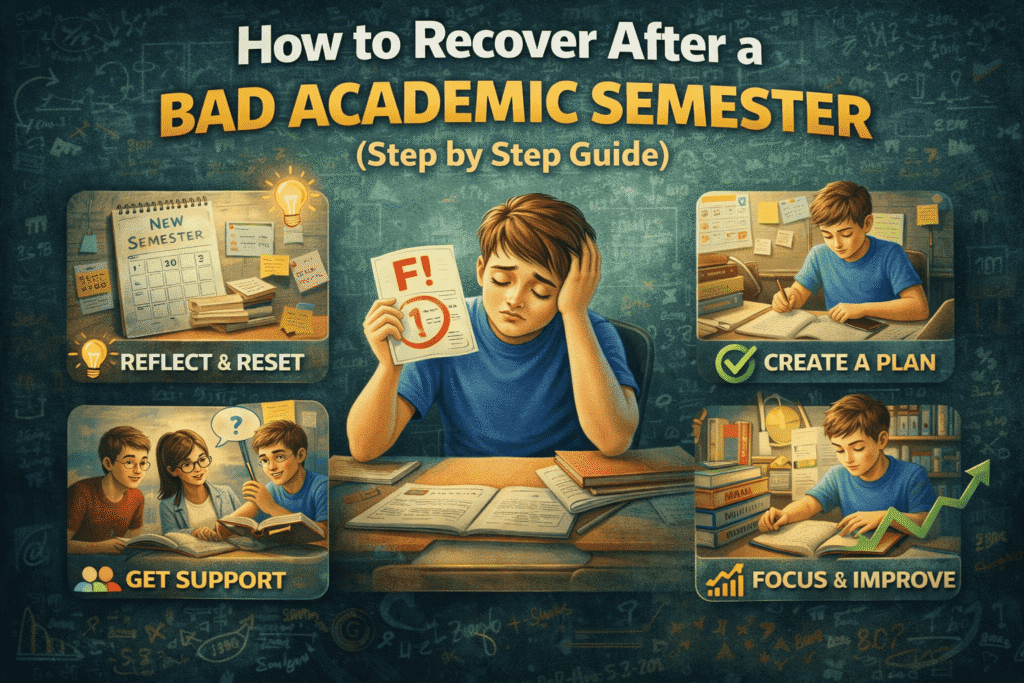
A bad academic semester can feel like everything is falling apart. Your confidence drops, motivation disappears, and you start questioning your ability. But here’s the reality:
👉 A single bad semester does not define your academic future.
👉 What you do next matters far more than what already happened.
Many high-performing students have experienced setbacks at some point. The difference is not intelligence, it is how they recover.
This guide is designed to help you rebuild your academic performance step by step with clarity, strategy, and realistic actions.
Step 1: Understand What Actually Went Wrong
Before trying to improve, you need to diagnose the problem properly.
Most students make the mistake of saying:
“I just didn’t study enough.”
But the real reasons are usually deeper:
- Poor time management
- Lack of consistent study habits
- Weak understanding of core concepts
- Ignoring assignments or internal marks
- Mental burnout or stress
👉 Without identifying the real issue, you risk repeating the same mistakes.
Take time to reflect honestly:
- Which subjects dropped the most
- Where exactly you lost marks
- What habits caused the decline
If you want clarity at subject level, using a semester grade calculator can help you break down your performance and see which areas hurt your results the most.
Step 2: Reset Your Mindset Before Your Strategy
Recovery is not just academic, it is mental.
After a bad semester, students often:
- Lose confidence
- Compare themselves with others
- Feel stuck or demotivated
This mindset can block improvement.
Instead:
- Accept the setback without overthinking it
- Focus on progress, not perfection
- Treat this as a reset point
👉 You are not starting from zero. You are starting from experience.
Step 3: Set Smart and Realistic Recovery Goals
Trying to jump from very low performance to perfect grades in one semester creates pressure and burnout.
Instead, set layered goals:
- Short term: Improve consistency
- Mid term: Raise subject level performance
- Long term: Improve overall academic standing
For example:
- Increase each subject score by 10–15 percent
- Stay above passing comfortably
- Build stable performance across all subjects
👉 Sustainable improvement always beats unrealistic goals.
Step 4: Build a System, Not Just Motivation
Motivation fades quickly. Systems create results.
You need a simple, repeatable study system:
Daily Structure
- Study 2–3 subjects in focused sessions
- Revise previous topics briefly
- Practice actively, not just read
Weekly Structure
- Review all subjects at least once
- Identify weak areas
- Adjust your plan
👉 Structure removes confusion and reduces procrastination.
Step 5: Fix Your Weakest Subjects First
Your biggest gains will come from your weakest areas.
Most students avoid difficult subjects, which makes the problem worse.
Instead:
- Start with your lowest scoring subject
- Break topics into smaller parts
- Practice consistently, even if progress feels slow
👉 Improving one weak subject can significantly boost your overall result.
Step 6: Track Your Progress Like a System
If you are not tracking your progress, you are studying blindly.
You should always know:
- Where you currently stand
- What you need to improve
- How much effort is required
Using a grade calculator allows you to:
- Estimate your performance across assignments and exams
- Understand how each score affects your result
- Stay above your academic targets
👉 This turns your study into a measurable process.
Step 7: Rebuild Your Overall Academic Performance
Recovery is not just about one subject. It is about your complete academic profile.
If your system uses GPA, tracking your improvement using a GPA calculator helps you see how your new performance is changing your overall standing.
For semester level clarity, a semester GPA calculator helps you monitor how each subject contributes to your recovery.
👉 This keeps you motivated because you can actually see progress.
Step 8: Change How You Study, Not Just How Much
Studying longer does not guarantee better results.
Focus on:
- Understanding concepts deeply
- Practicing questions regularly
- Reviewing mistakes actively
Avoid:
- Passive reading
- Last minute cramming
- Ignoring feedback
👉 Effective studying is more important than hard studying.
Step 9: Protect Your Energy and Avoid Burnout
After a bad semester, many students try to “overcompensate” by studying excessively.
This often leads to:
- Mental fatigue
- Loss of focus
- Reduced productivity
Instead:
- Take short breaks
- Maintain a balanced routine
- Prioritize sleep and mental clarity
👉 A focused mind performs better than a tired one.
Step 10: Stay Consistent Even When Results Are Slow
Recovery takes time.
You may not see immediate improvement, and that is normal.
The key is:
- Stay consistent with your system
- Keep tracking progress
- Avoid giving up after small setbacks
👉 Consistency is what turns recovery into success.
Final Thoughts
A bad academic semester is not failure. It is feedback.
It shows you what needs to change.
When you:
- Understand your mistakes
- Build a better system
- Stay consistent with your effort
You can completely transform your academic performance.
Your next semester is not defined by your past results. It is defined by the actions you take now.