
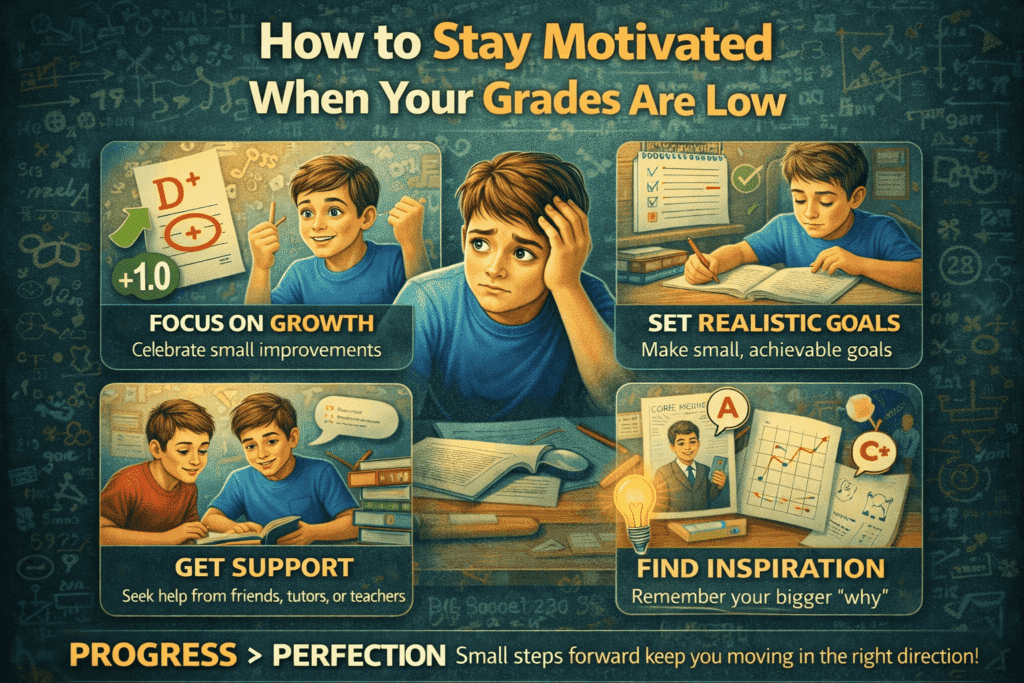
When your grades are low, motivation does not just drop slightly, it disappears completely. You sit down to study, but your mind keeps reminding you of your past results. You start questioning your ability, your effort, and sometimes even your future.
This is the point where most students go wrong.
They assume low grades mean they are not capable. In reality, low grades are not a sign of failure. They are a signal. Something in your approach is not working, and that can be fixed.
Why Low Grades Feel So Demotivating
Low grades affect more than just your academic record. They hit your confidence.
When results are not what you expected, your brain starts creating negative patterns. You begin to believe that no matter how much you try, the outcome will not change. That belief slowly reduces your effort, which then leads to even worse performance.
This is how students get stuck in a cycle.
The problem is not ability. The problem is the mindset created after the result.
The Shift That Changes Everything
The moment you stop seeing low grades as a judgment and start seeing them as feedback, everything begins to change.
Instead of asking yourself, “Why am I not good enough,” ask, “What exactly went wrong?”
That question puts you back in control.
It moves you away from emotion and into problem solving. And that is where real improvement begins.
Motivation Does Not Come First
One of the biggest misconceptions students have is that they need motivation before they start.
That is not how it works.
Motivation usually comes after action, not before it.
When you complete even a small task, your brain starts to rebuild confidence. That confidence creates motivation. Waiting to “feel ready” keeps you stuck. Starting, even when you do not feel like it, is what moves you forward.
Start Small, But Stay Consistent
Trying to fix everything at once creates pressure. Pressure leads to burnout, and burnout leads to giving up.
Instead, focus on doing less, but doing it consistently.
Study one topic properly. Understand one concept clearly. Improve one subject at a time.
These small actions may not feel powerful in the moment, but over time, they create real change. Consistency is what transforms effort into results.
Rebuild Confidence Through Evidence
Confidence is not built by positive thinking alone. It is built by proof.
When you start completing tasks, even small ones, you create evidence that you can improve. That evidence slowly replaces doubt.
If you want to make this process clearer, tracking your performance can help. Using a grade calculator allows you to see how even small improvements can affect your overall results.
This makes progress visible, and visible progress is one of the strongest forms of motivation.
Stop Letting One Result Define Everything
Many students make the mistake of judging themselves based on one test or one semester.
But academic performance is not one moment. It is a pattern over time.
Looking at your overall performance gives you a more accurate picture. If your system uses GPA, using a GPA calculator can help you understand how your results are shaping your overall academic standing.
This broader perspective reduces stress and helps you stay focused on long term improvement instead of short term disappointment.
Avoid the Trap of Comparison
It is very easy to look at other students and feel behind. But comparison is one of the fastest ways to destroy motivation.
You do not know their full situation, their strengths, or their challenges.
The only comparison that actually helps is this:
Are you doing better than before?
Even small improvement means you are moving forward. And that is what matters.
Build a Routine That Works for You
Motivation is unreliable. Routine is not.
When you create a simple daily structure, you reduce the need to constantly push yourself mentally. You do not need a perfect plan. You just need something you can follow consistently.
A fixed study time, a clear starting point, and a distraction free environment can make a huge difference.
Over time, discipline replaces the need for motivation.
Be Patient With the Process
This is where most students quit too early.
You might not see results immediately. Your grades might not improve in the next test. That does not mean your effort is not working.
Improvement takes time to show.
The students who succeed are not the ones who never struggle. They are the ones who continue even when progress feels slow.
Final Thoughts
Low grades are not the end of your academic journey. They are a turning point.
You can either let them define you, or you can use them to rebuild yourself with a better strategy, stronger habits, and a clearer mindset.
Start small. Stay consistent. Track your progress. And most importantly, do not give up too early.
Because once you start moving forward, even slowly, motivation will follow.