If you have ever compared GPAs with other students and felt confused by the difference, you are not alone. Two students can have similar grades but very different GPAs. One of the main reasons behind this is something called a weighted GPA system.
Understanding why schools use weighted GPA can help you better interpret your academic performance and make smarter decisions about your coursework.
What Is a Weighted GPA System
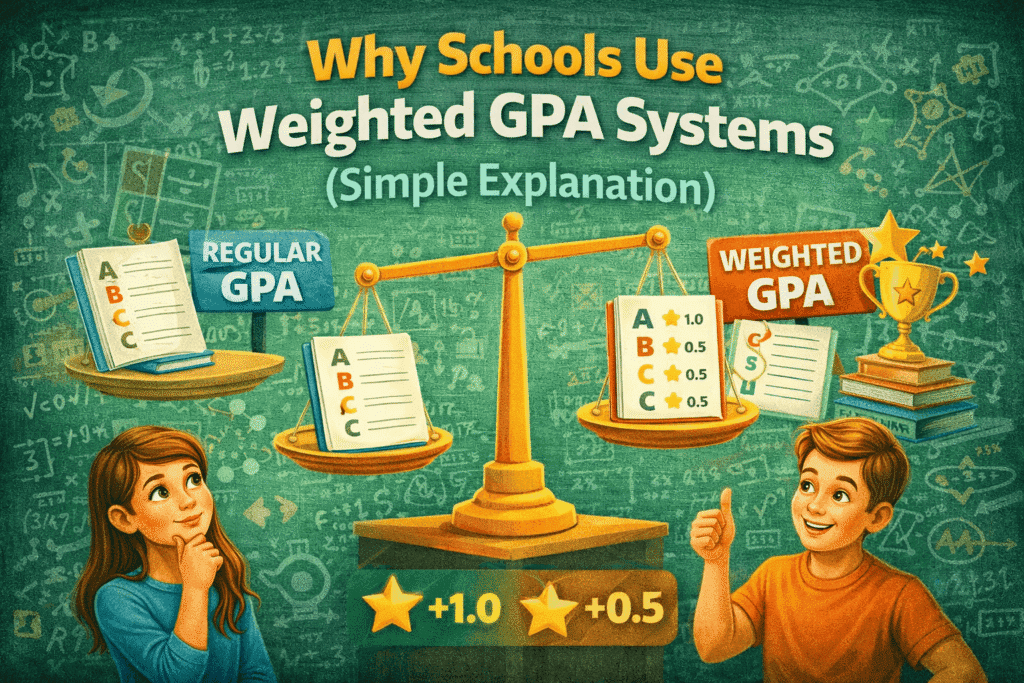
A weighted GPA system gives extra value to more challenging courses.
In a standard system, all classes are treated equally. But in a weighted system, advanced or higher level courses are given more weight because they require greater effort and deeper understanding.
Simple Example
- Regular course A grade = 4.0
- Advanced course A grade = 4.5 or 5.0
👉 This means students taking harder courses can earn a higher GPA.
Why Schools Introduce Weighted GPA
Schools use weighted GPA systems to create a fairer and more accurate evaluation of student performance.
To Reward Academic Challenge
Not all courses are equally difficult. Some subjects require more effort, critical thinking, and time.
Weighted GPA allows schools to:
- Recognize students who take challenging courses
- Encourage academic growth
- Value effort alongside performance
👉 Without weighting, students might avoid difficult subjects to protect their GPA.
To Encourage Advanced Learning
When students know that harder courses can boost their GPA, they are more likely to:
- Take advanced classes
- Challenge themselves academically
- Build stronger academic skills
This helps create a more competitive and growth focused learning environment.
To Reflect True Academic Effort
A student earning high grades in easier courses is not necessarily performing at the same level as someone succeeding in advanced classes.
Weighted GPA helps:
- Differentiate levels of effort
- Provide a more realistic academic comparison
- Highlight students who push their limits
To Improve College Admissions Evaluation
Colleges often look beyond simple GPA numbers.
A weighted GPA shows:
- Course difficulty
- Academic ambition
- Willingness to take on challenges
👉 This gives admissions teams a better understanding of a student’s capabilities.
Weighted vs Unweighted GPA
Understanding the difference is important.
Unweighted GPA
- Standard scale up to 4.0
- All courses treated equally
- Easier to compare across systems
Weighted GPA
- Scale can go above 4.0
- Extra points for advanced courses
- Reflects course difficulty
👉 Both systems are used, but they serve different purposes.
Does Weighted GPA Always Mean Better Performance
Not necessarily.
A higher GPA in a weighted system reflects:
- Course difficulty
- Academic effort
But it does not automatically mean:
- Better understanding
- Higher consistency
👉 Context always matters when comparing GPAs.
Common Misunderstandings About Weighted GPA
Higher GPA Always Means Better Student
A student with a lower weighted GPA might still have strong performance in difficult subjects.
Easy Courses Are Not Valuable
All subjects contribute to your overall learning. Weighted GPA simply highlights academic challenge, not overall worth.
Weighted GPA Is Used Everywhere
Not all schools use weighted systems. Some rely only on unweighted GPA for simplicity.
How to Use Weighted GPA to Your Advantage
If your school uses a weighted system, you can benefit by making smart academic choices.
Focus on:
- Taking challenging courses you can manage
- Maintaining consistent performance
- Balancing difficulty with your ability
👉 The goal is not to overload yourself, but to grow academically.
Understanding Your GPA Clearly
Whether your school uses weighted or unweighted GPA, tracking your performance is essential.
Using a GPA calculator can help you estimate your academic standing and understand how different courses affect your overall score.
If you want to see how individual subject scores contribute, tools like a grade calculator or a grade percentage calculator can provide additional clarity.
Final Thoughts
Weighted GPA systems are designed to create a fairer and more meaningful way to evaluate students. They reward effort, encourage academic challenge, and provide a clearer picture of student performance.
Understanding how weighted GPA works allows you to make better academic decisions and avoid common misconceptions.
Instead of focusing only on numbers, focus on growth, consistency, and choosing the right level of challenge for your goals.